Foudry masthead


SCOTCH  NATIONALITY

An Early Poem by the Corn Law Rhymer


boastingPic


"Scotch Nationality" was first published anonymously in 1824 when Ebenezer Elliott was 35 years old. Not really a young man, then, but the poet was still learning his trade. Copies of the 1824 version are very rare since Elliott bought up as many copies as he could and destroyed them. It is not clear why Elliott did this. With his earliest poems, the Corn Law Rhymer resolved to publish anonymously until he was a recognised poet. This suggests he had a lack of self confidence probably owing to his early years when he was a dunce at school and was under the shadow of his clever brother Giles. Possibly Elliott decided "Scotch Nationality" didn't qualify him yet as an established poet which is the reason for the poem not having an author's name.


Sowerby inscription
 In 1875 two of  his sons re-published the poem under the title "A Vision." Only 100 copies were printed. It's a mystery why they decided to re-publish the poem and why only 100 copies were printed.

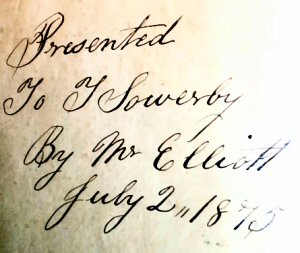
This article is based on the 1875 version. The flyleaf of my copy has the following  handwritten inscription: "Presented To T Sowerby By Mr Elliott July 2nd 1875." This fascinating inscription reveals the month of publication but we can only speculate about which Elliott made the inscription.


Where, though, did the original title come from? Elliott never visited Scotland but he had Scottish forefathers. Grandfather Elliott had married a strong Scottish woman whose maiden name was Sheepshanks; and grandfather's ancestors clearly intrigued Elliott: in his fragment of autobiography, Elliott boasted the ancestors were thieves "neither Scotch nor English." He added that they lived on cattle they stole from both! So evidently the poet took an interest in the colourful background of his Scottish ancestors.

Another poem by Elliott shows his interest in Scotland. "Scotsmen To Scotland" is a shorter poem "Written For The Scotsmen Of Sheffield." The poem admires the quality of Scotsmen but soon turns to "Poor, broken-hearted Burns" who had died far too soon. Another poem by Elliott is called "The Scotch Nationality." This short poem (below) confirms that the poet greatly admired Scotland for its independence, its liberty and its culture. It's a well crafted poem and a great contrast with Elliott's "A Vision."

The race that wrote the Bible never bowed  

Before the priesthood of the tyrant crowd;  

The race that raised the banner of the free  

And gave the world its flower of chivalry;  

The race that never yet to man has knelt,  

And never will—while hearts of men can melt;  

The race that loves the mountain and the flood,  

And heather purple in the solitude;  

The race that loves the battle and the breeze,  

The rocky glen, the cataract, the trees;  

The race that loves the ocean and the sky,  

And bids the eagle on his pinions fly;  

The race that loves the tartan and the plaid,  

And scorns the tyrant as it scorns the slave;  

The race that loves the pibroch’s martial sound,  

And hears it echo through the hills around;  

The race that loves the claymore and the targe,  

And rushes fearless on the foeman’s charge;  

The race that loves the thistle’s purple crest,  

And bears it bravely on its manly breast;  

The race that loves the freedom of the brave—  

The Scottish race, that never owned a slave.


"Scotch Nationality" is a long poem with 1010 lines in three books. Curiously the 1875 version uses the title "AVision" which is the subtitle of the original. Further, the title "Scotch Nationality" appears on the cover of the 1875 version but not on the title page, yet each of the three books is headed "Scotch Nationality Book 1" and so on. Why did Elliott's sons publish the poem anonymously and with a different title on the title page? Surely sales would have been stronger had the Corn Law Rhymer's name appeared on the title page? The whole thing is a mystery which is added to by the publisher's Advertisement which appears below:-


In August last, a stranger, about five foot seven inches high, and apparently about forty years old, left at the publishers a small parcel, and withdrew. He was well dressed, in a black frock coat and pantaloons, plain white neckcloth, tied behind, and low-crowned broad-brimmed hat. There were in the shop at that time, beside the shopman, a merchant of Thames Street, his daughter, and her grandmother, who, in their descriptions of the stranger, differ most unaccountably. They all agree that the expression of his countenance was wild and half insane; that his manner was a strange compound of awkwardness and audacity; and that, on the whole, he had the air of a man who had been stealing sheep, or attending a meeting for reform of parliament. The shopman is sure he has seen him play Jaques at Drury Lane; the merchant has no doubt he is a quack doctor; but the old lady knows him to be a Methodist parson, and has heard him preach; while the young lady feels satisfied that he is an Irish fortune-hunter, too ugly ever to succeed. The parcel was found to contain the manuscript of the following poem, and a letter from the author, without signature, and dated |Paris. I know little more of him. I have, however, reason to believe, that he is now in North America; and I am in expectation of receiving further information. In the meantime, the following particulars may be collected from the book itself; that he is an enthusiastic admirer of the Lake poets; that he is in politics a Whig, in religion wavering between schism and orthodoxy; and that he is a disappointed author, whose previous writings, whether deservedly or not, having been unnoticed by our leading Reviews, are neglected by the public.

There are a number of things to say about this Advertisement:-

    "In August last" would be August 1874.
    George Searle, writing under the pseudonym January Searle, says that the book was published by two of Elliott's sons, though we only have one here.
    The gent who presents the book was well dressed but did not impress the shopman or his customers (more about the shopman later). Each customer had an opinion and none of them  were flattering. Clearly the man caused quite a stir by his oddity! This could be George Edwin Elliott (1816-1901) who was a clergyman and who was well off. In 1876 (the year after "A Vision" appeared), George produced a two volume edition of his father's poems. As for the church, George was a minister in Antigua and Dominica. An oddity is that his manuscript included a letter dated Paris, not Sheffield as might be expected. Though as we have seen already, George was well to do and much travelled - so perhaps Paris could have been a destination for him.

The Title Page
 

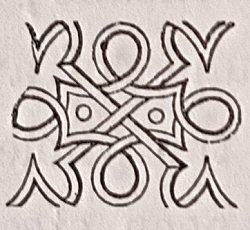
As we have already noted the title listed on the title page is "A Vision." The colophon  lists publication as Sheffield: W. Wilkinson, Printer, Gibraltar Street Post Office 1875. Sheffield Central Library has checked directories either side of 1875 and has not seen a post office listed for Gibraltar Street. However, further research shows Walter Wilkinson as Postmaster on Gibraltar Street from 1858 to 1881. Also an obituary has been found for Walter Wilkinson, printer. He died on April 20th 1891 at 246 Moorfields, Sheffield. It's odd that the Advertisement refers to the shopman and not to the postman or to the printer. It makes one wonder what sort of business operated at the premises. Below are printer marks used by Wilkinson in the book. The one on the left appears at the end of the Advertisement. The one on the right is much smaller than the other one & appears on the endpaper.


printers mark                                                                 Printer mark2

Printers marks were identifiers for the printer; a sort of trademark.


Gibraltar Street is also of  interest to students of the Corn Law Rhymer: Elliott's iron works had moved there from Burgess Street in 1829 and his son, John Gartside Elliott (1823-90), had a chemist shop at 180 Gibraltar Street. Possibly John was the person who handed in the manuscript at the post office. You would think, though, that the shopman would recognise John with his chemist business being on the same street as the post office (But we dont know how long John with his poor eyesight was actually in business on Gibraltar Street). In 1874 when the manuscript was handed in he would have been 51 years of age and he has been described as eccentric. He seems to fit the description mentioned in the Advertisement. Certainly he would have been one of the two sons mentioned by January Searle as being responsible for getting "A Vision" published.

Preface
""
Elliott provides us with a short Preface to his poem "A Vision." "The author of this poem is descended from gentlemen of the northern border." Further the poet writes "Zealous for the honour of the country, he celebrates the heroic virtues of Scotchmen, in suitable hudibrastics." Elliott then goes on to mention Sawney - a legendary Scots clan chief. According to the Newgate Calendar, Sawney murdered 1,000 people; some of whom were eaten by the gent. In the end, of course, Sawney was hanged. Elliott was intrigued by this tale since he mentions Sawney five or six times in "A Vision." At the end of the Preface, we see Elliott indulging in Scottish dialect: "What author, born north of the Tweed has written in praise of the fidge, the boo, and the grip." Note that Elliott  fails to conclude with a question mark.

Book One of "A Vision"

We learn that Elliott wrote the poem in 1822 and the poem is about a character called Mac Whisky:

In eighteen-hundred twenty two,
Mac Whisky hight, a Sawney true,
Half cloak'd with dust, and sick of clamour,
Left Sheffield and the sleepless hammer.
 
The name Mac Whisky seems to the modern reader a clumsy choice for Elliott to use for his hero, while Sawney appears to be treated as an alternative name for a Scotsman. Sheffield was full of noise and smoke, so our hero decides to leave behind the pollution and head out to the moors armed with a slice of Sheffield air which he hoped to be able to sell! Back in Line 1, we read that Elliott bought a hero from Wordsworth:-

I've bought a hero, one worth many,
A genuine pedlar. What he said,
Or dream'd, shall in Three Books be penn'd.
For your true Epic must I've read,
Have a beginning, middle, end;
So said the Scotchman, Aristotle.

Does this mean that the poem was inspired by Wordsworth? And please note that the poem is a dream. While Elliott is being humourous in claiming that Aristotle was Scottish! Many famous people are said to be Scotland born later in the poem ...

Mac Whisky climbs four miles out of Sheffield's squalor before the poet pauses to invoke his muse: Hail, fragrant Muse! thou'rt strang as whisky. After rambling on about the difficlty of being a poet and mentioning Scotch Greek, Scotch Yankey, or Scotch Cockney, Elliot describes the moorland scene with its flora and wildlife; which reminds Mac Whisky of Scotland. And of course it contrasts with smokey, noisy Sheffield. Our hero then falls asleep and dreams he has died; his spirit wanders and descends to hell. Which gives a clue about the reason for calling the poem "A Vision."

In notes at the end of Book 1, Elliott observes "A decree is gone forth that whoever writes a poem is an ass."  He then adds "The publication of a poem, by a man of sense, is become an act incomprehensible to a plain mind; it is deplorable, or ridiculous, in the extreme." He then comments on the Monthly Review, the Edinburgh Review, Blackwoods Magazine and the Unitarian Monthly.  He approves Blackwoods.  It would seem that the reviewers did not find the bard's early work to their taste which annoyed the young poet. In fact he hated the reviewers of the Monthly Review.


Book Two of "A Vision"

In Book 2 we have 323 lines of poetry and three pages of notes. Mac Whisky surveys the tortured souls in hell and notes scenes that Might draw a Tory's case-hard tear.  He spots various people being wash'd, with fire: a game-protecting squire, a reverend and a bishop (whose faith has not taken them to  heaven). Next came a reviewer and an eloquent sage - all doomed:  The rogues seem'd Tories, pitiless.  Elliott clearly has little time for reviewers and Tories! Presently Satan appears and a dialogue with Mac Whisky begins. It's an unlikely discussion on Scotland and its most famous inhabitants. Was Pope a Scotch, Satan asks? Was Swift? Was Locke? Was Shakespeare a Sawney? Mac Whisky claims them all! When Satan points out that Newton was English, Mac Whisky says  What! ken ye no' Mac Newton's clan?  Mac Whisky then boasts that the noblest men were true born Scots, even Sir Francis Chantrey, the famous sculptor from Sheffield, is claimed as Mac Whisky's cousin. Walter Scott was born in Scotland too and so was Francis Jeffrey, the  judge and critc who edited the Edinburgh Review. Mac Whisky then announces:-

The geatest heroes known to fame
Are Scotchmen, - Wellington and Grahame;
The greatest bard is Cunninghame.

Satan doesn't know Cunninghame but wonders if King Byron is dead. Elliott is no admirer of Byron and replies he's no longer King - But still of bards he's second best.  Satan then praises Jeffrey while Mac Whisky mentions Byron again and also the Sheffield poet and hymn writer James Mongomery. Note that Mac Whisky is respectful when addressing Satan:-

Sire! every Scotsman is a legion.
We congregate in every region,
Proud of our land of godlike men,
And if of her, still more of them,-
Smith, Spenser, Tasso, Arkwright, Pen,
Seth, Deuteronomy, and Shem.

Satan then enquires where those famous Scotsmen Homer and Dante were born. In Inverness and Leith was the reply! Satan then offers Mac Whisky a return to England which Mac Whisky refuses. Satan is intrigued and asks Is England like a barren waste compared to Scotland?  A mere bog is the reply. Nor is Mac Whisky complementary about the English. Book 2 ends with Mac Whisky offering the slice of Sheffield air he had brought with him. Mac Whisky reveals that Sheffield air is so thick that it is like pork! Satan is astonished, goes red in the face, then blue, then white and red again!

But our Third Canto shall display
(In lines, good reader, we assure thee,
Worth more than twice their weight in brass,)
What hell's wise prince did in his fury,

And what hereafter came to pass.


Book Three of "A Vision"

Book 3 is the longest book with 389 lines and 10 pages of notes. Elliott begins again by mentioning his muse:

How can I, poor in verse, refuse
Th' assistance of the fragrant Muse?

Then, as at the beginning of Book 1, he refers to Wordsworth and the subject of a pedlar:-

Nor have I Wordsworth's power to sing
Of pedlars, and that sort of thing.

Turning back to the slice of Sheffield air that Mac Whisky had imported to hell, the air gets thrust at Satan who decides To knock some sense of decency into Sawney's head and drops a three thousand ton weight on him. Our hero is made of strong stuff, though, and just gets up calling for whisky. This is followed by  a tirade from Satan about English writers and the stupidity of their readers. He mentions Byron (again), Swift, Milton, Scott and a few others. It appears that Satan has a low opinion of English writers:-

The Scotch have found, by th' second sight,
That none, born south of Tweed, can write.

Satan then decides to hang Mac Whisky who is seized by two giants. But a strange creature appears and intervenes. The creature is named as an Apparition and begins to speak to Satan who moves away and climbs up out of reach. He seems to recognise the Apparition though Elliott doesn't identify him.

I know thee now, dread Hack! I see
The Tory of the Whigs in thee,
Add that praise to thy other glories;
A half Whig is the worst of Tories.

The Apparition then teases Satan with an allusion to Catherine Godwin, a poet and novelist. Satan & the Apparition tangle over Godwin's ABC and over basic arithmatic. At length, the Apparition turns his attention to Mac Whisky and asks:-

Half-witt'd, and degenerate Scot!
Thou shame of Scotland, though a sot!
What dost thou here ...?

The Apparition then lashes Mac Whisky with a whip causing him to yell out aloud which makes Mac Whisky wake up with a start:-

And poor Mac Whisky, pale as lead,
Awak'd, in diuretic dread,
Tho' wet, quite sound in wind and limb;
No fiend had dar'd to injure him.


Mac Whisky is pleased  to see he still has his slice of precious Sheffield air and finds himself in pleasant surroudings above Loxley and the Rivelyn Valley. (Loxley village in now a suburb of Sheffield; Rivelyn Valley was a favourite walk of the Corn Law Rhymer). "A Vision" ends with Elliott reminding the reader that the poem was a dream:-

He then, with Nature, clos'd his eye,
His cares, hopes, dreams, at once forgot.


After the end of Book 3, there are a few pages of notes. These includes two letters written to the editor of local newspapers by "a plain tradesman" who was clearly Elliott. The first is dated Oct 28 1822 and is signed PF. The second letter is dated Dec 22nd 1822 and is also signed PF. The initials stand for "Peter Faultless" which was the title of a poem by Elliott published in 1820. The poem was Elliott's sarcastic attack on the Monthly Rev
iew journalist who, according to Elliott, was a know-all who thought he could do no wrong.  (The critic had panned Elliott's volume of poems called "Night" which had been published in  1818). Elliott sometimes used the initials PF when writing to Sheffield newspapers. Both letters were in answer to letters seen by Elliott in the local newspapers. The first letter comments on taxation, fund holders, farmers rents and the Bank Registration Act. The second letter is an indignant reply from Elliot who was criticised about not knowing the difference between parish rates and taxation.


Final Remarks About The Poem


"Scotch Nationality," published in 1824, was the sixth volume of poetry by the Corn Law Rhymer; earlier works had received some national reviews - though these had been very critical.

We now need to have a look at the circumstances Elliott faced in the early years of his poetical development. In 1819, after a bankruptcy in Rotherham, the poet moved to Sheffield where his new iron business prospered and where he gained a reputation as a shrewd operator. By 1822, after the death of his father, Elliott was the head of the family (a large one). He was doing well in business and was a published poet - so he was making go
od progress in life. In  1823, Robert Southey, the eminent Poet Laureate, visited Sheffield and met Elliott. Southey had read some of Elliott's early work and said there were signs of talent in his poetry. Southey's encouraging remarks were a great boost for the Corn Law Rhymer - as Elliott was known a few years later. It is against this background that "Scotch Nationality" appeared. It was published in London by Charles Stocking who had also published Elliott's volume "Love" in 1823. While "Love" was extensively reviewed, no reviews have been found for "Scotch Nationality" which is very strange.

We have already seen  that Elliott bought up and destroyed all the copies of "Scotch Nationality" that he could find. This tells us two things: one - that he was pretty well off at the time to be able to buy up copies, and two - that he was far from happy with the poem. January Searle suggested this was because the poem painted Sheffield in a bad light. This is unlikely since the poem does not dwell too much on the noise and smoke of the cutlery industry. If anything the poet is affectionate about the air in Sheffield. The most likely cause of Elliott deciding to destroy copies is the reaction of friends, relatives and family especially if they had purchased copies. Surely he would have received negative feedback about the plot and the lack of quality of the poem?

As a young man, Elliott  often wrote poetry around macabre incidents; something we can see in Mac Whisky's descent into hell and the strange dialogue with Satan. But strange things do happen in dreams though - and remember the subtitle of the poem is "A Vision."
Another possible motive for Elliott with his Scottish ancestry was to portray Scotland in a good light by claiming all famous writers were born in Scotland. Whatever were his intentions, the poem does not work - and it is easy to see why Elliott scrapped the poem.

Why though did Elliott's sons re-publish the poem 25 years after their father's death and why was it re-titled "A Vision"? It seems unlikely that the idea was to mark the 25th anniversary of their father's death since they published the book without Elliott's name. Why did they drop "The Scotch Nationality" title for the "A Vision" title? Perhaps they thought the dream theme was more central to the poem than  dubious (but amusing)
references to Scotland?

In 1876, a year after "A Vision" was published, Edwin Elliott published a two volume collection of his father's verse. Preparing the poems for publication would have been a lengthy process, and work on the volume would have commenced long before "A Vision" was published in 1875. The collected verse contains some very long poems, so "A Vision" was not omitted for space reasons. Edwin was known to leave out some poems he did not like - which may explain the omission. If he disliked the poem so much, why did he bother publishing the poem separately? The fact that "A Vision" was a limited edition of a hundred copies suggests that Edwin and brother John did not want to waste good money on a bad poem! Given that copies of "Scotch Nationality" were destroyed the brothers may have decided to ensure their father's poem did not disappear entirely.


It's all a Mystery, isn't it ?
To return to the Ebenezer Research Foundry, please click the Anvil     anvil

Click here to return to Ebenezer's Home Page

For a study of other early poems by the bard, click here