The Mystery of John Watkins, Chartist
Who was John Watkins?
He was the son-in-law of Ebenezer Elliott, the Corn Law Rhymer. Watkins was a fervant Chartist, a playwright and poet. He was born in 1809 at Aislaby Hall near Whitby. For more biographical information visit the webpages Friends and Acqaintances of the Corn Law Rhymer.
What was the mystery about Watkins?
We have two dates for his death: 1850 and 1858. The late Professor Malcolm Chase, who was an authority on Chartism and John Watkins, states that Watkins died in 1858. Further, an AI search has shown that the death occured in Jan 1858 when Watkins committed suicide in London while writing his biography. There is a great discrepancy here, since the grave in Darfield churchyard clearly states that Watkins died in 1850. See the photo below where the insciption is clearly incised and neither eroded nor obscured by moss. I visited the grave many years ago and took this photo. When I contacted Malcolm Chase, he commented that he had been surprised by the lack of activity shown by Watkins in the years up to 1858.

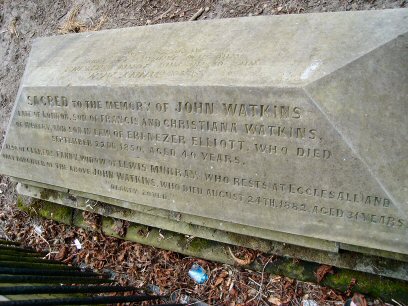
The grave of John Watkins in Darfield church
His wife, Fanny Ann, is also in the grave
The Professor's comprehensive article and bibliography on Watkins can be seen at georgemarkhamtweddell.blogspot.com.
Note
that the last work by Watkins listed in the bibliograpy is 1847 and the
last
meeting listed is 1848. No literary work after 1850. And Chase expresses surprise that he did not come
across any documentation for Watkins in the Whitby area in the
years running
up to 1858. Could there have been confusion over the name Watkins which
is a common name after all? Note too that Chase found that Watkins wrote a
will in August 1850, a sign that he was on his last legs or had some
bad news about his health. He was only 41 when he died. A cause of
death has not emerged.
There is a strong case for Watkins living in London: on his grave the inscription reads "late of London" for instance. It is significant that the inscription does not read "of London." We know that he was in Darfield (near Barnsley) on November 17th 1849 when he married Fanny Ann, Elliott's daughter. We know that Elliott had earlier written to Watkins on November 9th 1849 to tell him to come and marry Fanny Ann as the poet had little time left. On receiving the letter, Watkins said "I hastened to the north." When Elliott died on 1st of December, Watkins was there holding his hand.
After the marriage on November 17th 1849, Google reports that the couple lived in Sheffield, although Chase has them living in London. After her husband had died in 1850, Fanny Ann Watkins was living in a rented house in Shiregreen, Sheffield. Very likely her husband had rented the house when he hastened up to Yorkshire following the letter from Elliott and pending his marriage to Fanny Ann. Professor Chase has Watkins marrying Mary Elliott though not Fanny Ann. This is a mistake since Elliott only had two daughters - and neither were called Mary. Chase also has an earlier wife for Watkins when he was living in London. She was the daughter of a stonemason but Chase does not give her a name. Was it possibly Mary? Maybe that's where Chase got the name Mary from?
Watkins' Biography of Ebenezer Elliott
This book was published in London in 1850. The book was dedicated to Sir Robert Peel. The dedication bears the date 1st July 1850 and the address for Watkins is Clapham Rise, London. The book is called "Life, Poetry and Letters of Ebenezer Elliott, Corn Law Rhymer." While the publication date is 1850, it is obvious that the 273 page book was started a little earlier than 1850. In fact, Elliott requested before he died on December1st that Watkins should write his biography. Watkins died in September 1850 - it is not clear if Watkins lived to see copies of his book.
John Watkins - born 1809 and died in Sheffield 1850
He was the son-in-law of Ebenezer Elliott, the Corn Law Rhymer. Watkins was a fervant Chartist, a playwright and poet. He was born in 1809 at Aislaby Hall near Whitby. For more biographical information visit the webpages Friends and Acqaintances of the Corn Law Rhymer.
What was the mystery about Watkins?
We have two dates for his death: 1850 and 1858. The late Professor Malcolm Chase, who was an authority on Chartism and John Watkins, states that Watkins died in 1858. Further, an AI search has shown that the death occured in Jan 1858 when Watkins committed suicide in London while writing his biography. There is a great discrepancy here, since the grave in Darfield churchyard clearly states that Watkins died in 1850. See the photo below where the insciption is clearly incised and neither eroded nor obscured by moss. I visited the grave many years ago and took this photo. When I contacted Malcolm Chase, he commented that he had been surprised by the lack of activity shown by Watkins in the years up to 1858.
Professor Chase
The grave of John Watkins in Darfield church
His wife, Fanny Ann, is also in the grave
There is a strong case for Watkins living in London: on his grave the inscription reads "late of London" for instance. It is significant that the inscription does not read "of London." We know that he was in Darfield (near Barnsley) on November 17th 1849 when he married Fanny Ann, Elliott's daughter. We know that Elliott had earlier written to Watkins on November 9th 1849 to tell him to come and marry Fanny Ann as the poet had little time left. On receiving the letter, Watkins said "I hastened to the north." When Elliott died on 1st of December, Watkins was there holding his hand.
After the marriage on November 17th 1849, Google reports that the couple lived in Sheffield, although Chase has them living in London. After her husband had died in 1850, Fanny Ann Watkins was living in a rented house in Shiregreen, Sheffield. Very likely her husband had rented the house when he hastened up to Yorkshire following the letter from Elliott and pending his marriage to Fanny Ann. Professor Chase has Watkins marrying Mary Elliott though not Fanny Ann. This is a mistake since Elliott only had two daughters - and neither were called Mary. Chase also has an earlier wife for Watkins when he was living in London. She was the daughter of a stonemason but Chase does not give her a name. Was it possibly Mary? Maybe that's where Chase got the name Mary from?
Watkins' Biography of Ebenezer Elliott
This book was published in London in 1850. The book was dedicated to Sir Robert Peel. The dedication bears the date 1st July 1850 and the address for Watkins is Clapham Rise, London. The book is called "Life, Poetry and Letters of Ebenezer Elliott, Corn Law Rhymer." While the publication date is 1850, it is obvious that the 273 page book was started a little earlier than 1850. In fact, Elliott requested before he died on December1st that Watkins should write his biography. Watkins died in September 1850 - it is not clear if Watkins lived to see copies of his book.
John Watkins - born 1809 and died in Sheffield 1850